

Lessons in Breathing: Lesson Two, When to Do Breathing Exercises
How do you know when to do breathwork?

About This Series
This is part 2 in a 4-part series about breathwork with me, Alea Quiles, your breath coach and breathing bestie.
Here at Heal House, your home for transformation and healing magic, I write about healing, self-development, and spirituality. You’ll find many rooms in the house of healing, from health to gardening, to rituals, to nature connection, and beyond.
This is your invitation to find the healer within.
Links to all letters in this series will be added as they are published. Here is the link to Lesson One.
So be sure to subscribe! You don’t wanna miss any lessons »
Benefits of Breathing Exercises
There are so many benefits to breathing, it’s astonishing. From pain management to cultivating a sense of calm it has everything going for it as a daily healing technique that will impact your life in unimaginable ways. All without an expensive price tag, special tools, inaccessible postures, or other barriers to entry. All you need is your breath and intention.
Here’s a list of just some of the benefits:
Energizes you in the morning
Balances you in the afternoon
Helps you to fall asleep
Helps with digestion
Reduces inflammation
Manages stress
Manages pain
Reduces anxiety
Reduces depression
Reduces stress
Helps to lose weight
Assists in managing asthma symptoms
Helps repair muscle tissue post workout
Helps blood pressure
Improves endurance
Improves lung function
Connects mind and body
Helps with intuition
Boosts mood
Provides mental clarity
Regulates the nervous system
Boosts immunity
Reduces toxins
Relieves emotional stress
Transmutes shadow work
Provides overall well-being
Breathing exercises can be applied to nearly every aspect of your life. Like, my pelvic floor PT has me doing breath exercises to strengthen those muscles. Which I already knew how to do, but that’s for a later discussion. Mindful breathing can be incorporated to your morning routine, your bedtime routine, your exercise regimen, nearly any time you have to make it a practice - you can do it.
Of course, here’s a word of caution: breathing exercises should never be practiced while swimming, in or near water, and certainly never in ice water.

🎁 Subscription Gift Opportunity
Subscribe to Heal House and you will receive not only a FREE breathwork audio, but also a 15% discount on any one of my products and meditation bundles 🙏🏻 My appreciation to you for being a reader and community member. Upgrade and receive a discount on any service I provide! Yes, that includes the Healing Breath Workshop below!
When to Do Breathing Exercises
As mentioned in Lesson One, one of the important things to do when practicing breathwork is to know what your intention is, and why you are practicing. Is it to wake up? Is it to become more alert? Is it to go to sleep? Is it to prepare for a lecture? Is it to experience an out of body experience?
Knowing the why is extremely important because breathwork alters your brain chemistry and activates your nervous system.
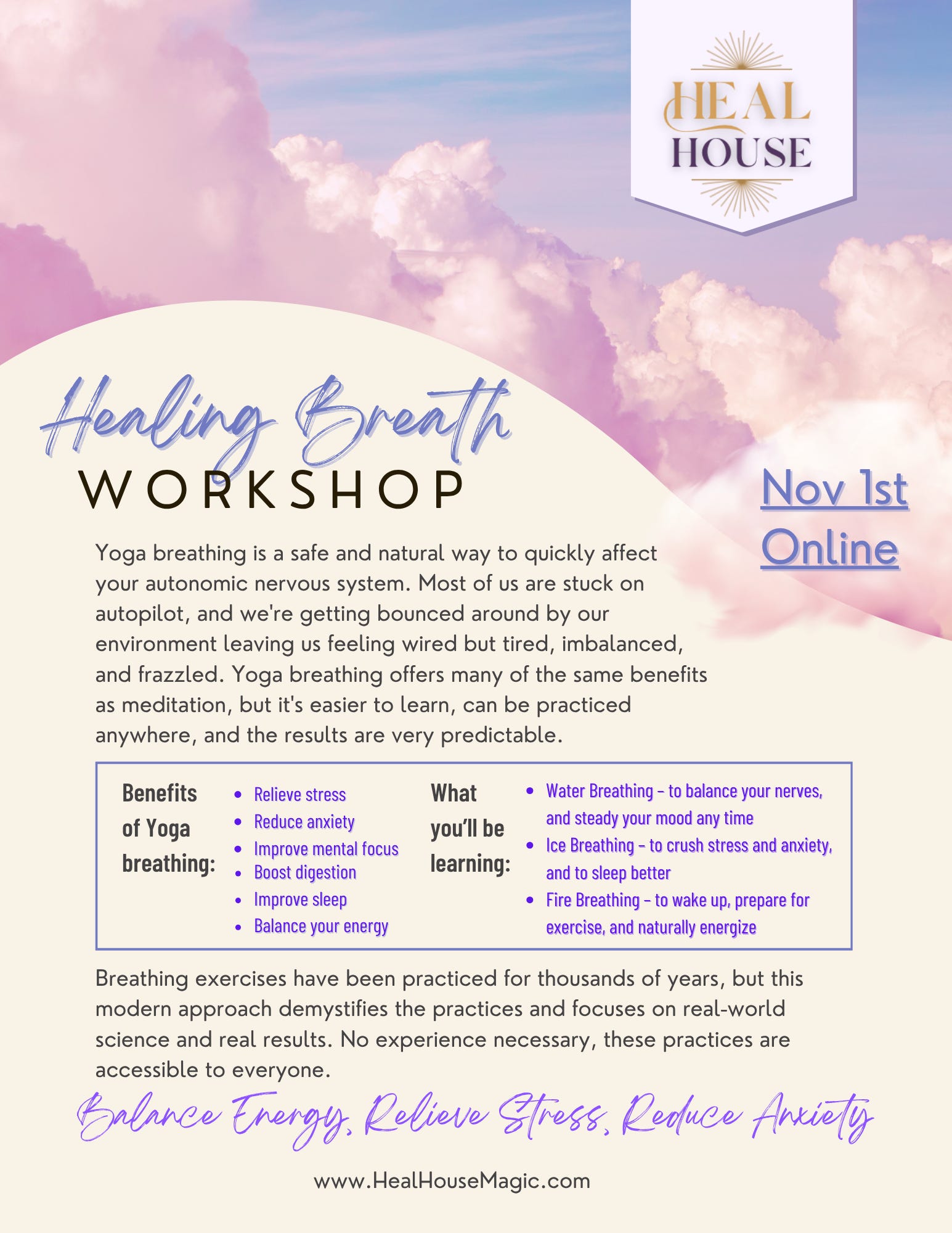
That’s why in the Healing Breath Workshop I’m hosting on Nov 1st, we practice breathing exercises in categories. Some you do in the morning, some in the afternoon, and some in the evening. Others you do before working out, and some you do to cool your nerves.
I teach these in different categories.
The Coffee Category of breathwork exercises would be like coffee on the nervous system. Stimulating, activating, and up-regulating.
The Water Category of breathing exercises would be for balancing out wherever you are. Mindful breath. Just like water, which you can drink any time during the day, these exercises are much the same.
The Tea Category has down regulating breathing exercises that help you to relax, destress, and get ready for bed.
Knowing this information will build a solid foundation of breathwork that will help you in the future for when you take your healing practice into daily life. You’ll be able to ascertain which exercises are going to help you the most, no matter what you’re up against, or what you want to achieve.
Below are some helpful examples:
When to do Box Breathing
You’ve probably heard about box breathing at some point. This breathing exercise follows a rate:ratio of 4:4:4:4 (for 10 rounds or more), which can be represented as a square or box. Inhale for a count of four, hold for a count of four, exhale for a count of four, and hold for a count of four. There are many different examples and videos of this practice on YourTube, online, and in the workshop.
Box breathing is safe and effective for cooling down your nerves. It helps to activate the parasympathetic nervous system which is responsible for rest and digestion as well. It’s safe enough for children to use and is a great way to get them to settle down before bed.
This exercise is best performed before bed as a part of your nighttime routine, after eating, and for anxiety relief.
When to do Breath of Fire
Breath of fire is a form of controlled hyperventilation. Anytime you are breathing more than 20 breaths per minute, it is considered an activating and up-regulating breathing exercise. This type of breathing pattern activates the sympathetic nervous system which controls your fight or flight response. It also constricts your veins and airways. Holotropic breathwork uses controlled hyperventilation to induce mental states of euphoria or a natural “high” to help aid in the healing process.
However, this form of breathing exercise should be practiced with caution for short duration use or with a trained breathwork facilitator for an extended duration. It is highly potent and extremely effective.
In the Healing Breath Workshop, I give my students a Breath of Fire audio to practice in the morning and it is only 3 rounds of 10-20 breaths. Very brief, quick, can be practiced on your own, and is highly effective.
This exercise is best in the morning, and before working out.
Do not do these exercises (including Holotropic) if you have a history of anxiety, panic disorder, or wake up with stress. For my students who fall into those categories I suggest they use balancing breath instead.
When to do Deep Breathing
Deep breathing is much like box breathing in the way it cools your nerves, and opens airways. Deep breathing can be done briefly for managing stress, helping digestion, reduces anxiety, boosts mood, helps to regulate blood pressure, helps asthma symptoms, and is a down regulating form of breathing.
Deep breathing should be practiced after eating, in the evening, before bed, and/or through tough emotions. Deep breathing can make you extremely relaxed and therefore sleepy.
An example of deep breathing would be the famous 4:7:8. Inhale for a count of four, hold for a count of seven, exhale for a count of eight. Do this for three rounds max.
🌬️Deep Breathing Exercise
How was that? Let us know in the comments!
Healing Breath Workshop
Here’s a quick overview of the workshop I will be teaching starting Nov 1st. Are you ready to discover the hidden power of your breath?
If you have any questions or want to chat, send me a message or post it in the chat!

Complimentary Reading
Next Tuesday we will continue Lessons in Breathing with the third lesson on How Breathing Exercises are Good for Anxiety. Be sure to subscribe so you don’t miss it! In the meantime, you can read some complimetary articles about breathwork that I have written, like:
Breathwork: Where to Start
What are We Speaking into Existence?
And Podcast Episodes -
Episode 10: The Power of Your Breath
Episode 12: The Shape of Air
Episode 23: What They Don’t Tell You About Breathwork
Mindful Breathing
This is just a brief overview of the vast and complex world of breathing and is not nearly long enough to go over the nuances of each and every exercise and practice. If you want more of a deep dive, keep coming back on Tuesday’s or join the Healing Breath Workshop. Your mind will surely be blown!
Thank you for being here <3
I’d love to connect and hear from you!
with Love and Magic Always,
xo Alea
In the giving mood? I’d be so grateful if you bought me a coffee!
See you Friday on the Heal House Podcast.
p.s. In no way shape or form do I treat, diagnose, or cure. Please consult a medical professional before attempting anything new. Breathwork should never be done around or in water, or while driving.